Slowness uses cookies to enhance the quality of our website. You can control how these cookies and similar technologies are used by adjusting your settings in My Preferences. To learn more about which cookies we use and how to edit your preferences, read our Cookie Policy.
PREFERENCES
Slow uses cookies to enhance the quality of our website. You can control how cookies and similar technologies are used on this website by making a selection below.
Save Preferences
Want to learn more about our people, places and projects? Sign up below to get our occasional newsletter.
The Long Talk

SLOWNESS CONVERSATION

A Sense of Being at Ease: Designing with Norm Architects

The spaces we inhabit exert a potent influence on our state of being, our ways of gathering, and the culture we create. By drawing on timeless principles of design and humanity’s deep history, Norm Architects has designed the interiors of Flussbad as intuitively navigable contexts for a creative life. In this Slowness Conversation, they offer an insight into their approach.

  • TEXT Aurora Solá
  • ART DIRECTION João Drumond

The spaces we inhabit exert a potent influence on our state of being, our ways of gathering, and the culture we create. By drawing on timeless principles of design and humanity’s deep history, Norm Architects has designed the interiors of Flussbad as intuitively navigable contexts for a creative life. In this Slowness Conversation, they offer an insight into their approach.

  • TEXT Aurora Solá
  • ART DIRECTION João Drumond

Three decades ago, Juhani Pallasmaa put his finger on the malaise of twentieth-century architecture: “Modernist design at large has housed the intellect and the eye, but it has left the body and the other senses, as well as our memories, imagination and dreams, homeless.” Today, a new generation of architects has taken the critique as a summons, integrating the findings of anthropology, biology and neuroscience to create shelters for the whole person, not just the thinking one. As leaders of this new wave, Norm Architects in Copenhagen have helped to redefine minimalism, building spaces that privilege the full-bodied human experience over the personal statement of the designer. Commissioned for the interiors of Flussbad, the Slowness campus in Berlin, they brought to the project their signature sensitivity to the emotional registers of light, material and ritual. Sofie Thorning, partner at Norm, spoke with us about this work and about the convictions that shape it.


AURORA SOLÁ I’m curious about the name Norm. Can you tell me about why it was selected?

SOFIE THORNING It was very intentional, actually. Norm Architects was founded in 2008, in the midst of an era in architecture that was about maximalism and expression. There were also new 3D technologies, digital developments and new materials coming out, and this is after decades of optimizing and rationalizing architecture and the built environment. At that point, the thought was, is this really the right way to go? Or could we look instead at what the standards were and why they are there? We decided to build on something that worked, continuing to develop it and make it better. We believe that we really stand on the shoulders of others and the norms are there for a reason.

AS It’s almost a restorationist impulse.

ST Yes, though not in the sense of simply looking backward. It’s about understanding the wisdom embedded in the ways we have built and lived over time. There are reasons why certain spatial qualities, materials, and proportions continue to resonate with us. Our human-centric approach starts from that understanding. Rather than replacing that with novelty for its own sake, we try to refine, reinterpret, and build upon – learning from what already works while improving it through contemporary knowledge, technologies, and needs.

AS And you personally, Sofie, what was it that drew you into architecture?

ST It’s a good question. I think that I’m very much a product of my parents, who are two completely different people. My father is an engineer and very rational, and my mother has a degree in Russian literature and language, and basically takes the complete opposite perspective on the world than the very logical approach of my father. I think I have fused these two elements. Architecture is something that is built on rational principles but can capture everything else in life within its framework.

AS A rational net for capturing the emotional.

ST Exactly.
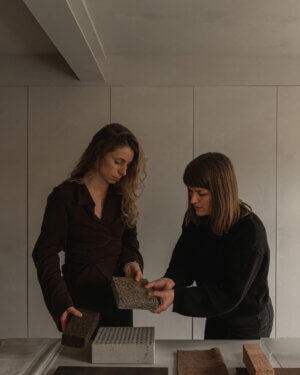
Sofie Thorning

“…we design for all the senses, because we deeply feel that it has an enormous impact on our daily mental health and well-being.”

AS At Norm, you talk about re-sensualizing minimalism. This makes me think of that other Scandinavian Juhani Pallasmaa and his essay The Eyes of the Skin. He describes the way modern architecture has developed towards sight, which is the most distant, most rational and Apollonian of the senses. And then, as you start coming closer, you have scent, and then you have taste and touch, which are the most intimate of the outward senses. These have hardly been considered in modern architecture. Could you tell us how you go about designing for the many senses of the human animal?

ST There is a human nature, human biology, that is at play when we talk about designing for the senses. I think in the process of optimizing architecture, the haptic and the tactile were forgotten. It wasn’t deliberate, but in the urge to create efficiency and speed in the construction industry, and to innovate materials that are maintenance-free, we lost a lot of what makes us comfortable as humans. There’s a big difference between touching a synthetic material and a natural one. It’s not just a trend that we like wood. It is something that speaks to humans at a deeper level. From the time we are children, we gain an understanding of materials from touching things or even putting them in our mouth. We develop a sense of what is comfortable to our skin. So what we are trying to figure out is what it is that humans resonate with in terms of our spatial environment and materials universally, no matter where you’re from culturally or which background you have. That’s why we design for all the senses, because we deeply believe, and scientific research backs this up, that it has an enormous impact on our daily mental health and well-being.

AS So that’s the why. And what’s the how? What are some of the questions you consider to deliver this vision within walls?

ST A big part is understanding that our primordial home is nature. We come from nature, and everything that is in nature speaks to us at a deeper level. So, for instance, it’s how daylight enters spaces. It can be harnessed architecturally to create grandeur or intimacy. In churches it has been used to create something that is almost divine. And on a daily level, in our work environments or our houses, the importance of how you get daylight inside just can’t be overstated. Then it’s our relationship with nature in terms of materiality, as I just touched on. Natural materials are something that we immediately understand. When you see a stone surface, you automatically know that it’s going to be hard, it’s going to be cool to the touch. You can see with the eye how it’s going to feel when you have a textured woven linen. You already know that it’s going to have some softness to it, a warmth to the touch, but also a little bit of roughness. It’s part of us. So that’s sensing and touching.

Then there’s color. Advertising makes use of colors that are really strong to catch our attention – reds and yellows and neons coming at us. We think colors should actually be the opposite. We know that more natural tones biologically ease the nervous system and relieve stress, so by using natural, muted colors, we design spaces that work with our biology rather than against it.

Then there is the sense of hearing. We’ve all been to schools or spaces that are poorly treated acoustically and we know how that affects us. We try to bring in solutions for acoustics that are invisible and integrated so that you don’t have noise pollution on top of everything else that’s coming at you during the day.

And then there’s smell. Smell is so deeply rooted in us — again, primordial. We have long relied on it for survival, as a reliable indicator, for instance, as to whether food is good or bad. At the same time, smell is something that evokes memory. A passing scent can suddenly bring back something you haven’t thought about for years. In that sense, scent becomes a powerful atmospheric tool. We can draw in the fragrances that belong to a place – the smell of seaweed and sand if we are near the waterfront, for example – to create a stronger conceptual and sensory connection to the surroundings. In the same way, a wooden floor introduces the subtle scent of the forest, something far more alive and familiar than the neutrality of materials like linoleum.

Taste, of course, in architecture is a little bit more difficult. But actually, when you design a restaurant, the question of how you illuminate the food is a big part of how you experience the food. And that again influences how you smell it. If the lighting on the food is creating dull colors, you pre-condition the idea of how it’s going to taste.

AS I think too of that marvelous scene in The Eyes of the Skin where he talks about kneeling to put his tongue to a threshold stone. You are absolutely right that, with natural materials, we don’t have to touch them to know what they feel or taste like. That memory is intuitively built into us. It is imagined touch as well as actual touch that informs our experience of a space.

ST That’s it.

Sofie Thorning

“You are out in the urban world receiving all of these stimuli all day, but maybe you get to Flussbad and you experience a kind of relief in entering into a space that’s calm and instantly sets you at ease. That’s what we’re aiming for.”

AS You’ve now run us through each of the senses, and all of this adds up to a feeling. For Christopher Alexander, the measure of a house’s success was his client’s well-being. I’m curious as to how you would describe the experience that you’re trying to create. Is it about health? Holding the human creature? Is it about pleasure, concentration? Elevation — as in ecclesiastical architecture, trying to lift the spirit, the gaze, the posture? What is the feeling that all of this should add up to for Norm?

ST It is absolutely about creating human well-being, and not in the sense of going to the spa and feeling relaxed. It’s about these fundamental senses of security, feeling comfortable. We are really trying to relieve our biological selves of all these impulses that modern society has come up with to get at our attention. You are out in the urban world receiving all of these stimuli all day, but maybe you get to Flussbad and you experience a kind of relief in entering into a space that’s calm and instantly sets you at ease. That’s what we’re aiming for.

AS That’s beautiful. In a world that’s jostling to snatch our attention away, you want to give attention back to people for them to direct as they would.

ST Exactly. And I think that really ties us to Slowness, because you need to shed all these impulses that are constantly coming at you in order to slow down. That’s why we feel very connected to the idea of slowness.

AS Can you talk a bit about how the partnership with Slowness developed? What first struck you about the project?

ST When we were approached by Claus Sendlinger, he described a project that was extremely ambitious in addressing the human being on a holistic level. We understood that we had a very similar sense of design and what design should do. And that paired with this beautiful piece of architecture that is the Werft, which is in itself quite expressive. We needed to merge the other ideas for the campus with our sense of general well-being. So I think it was the ambition, the complexity of the brief, and a very clear, common goal of creating something new in hospitality that really expressed the idea of slowness and a focus on what is universally human. That was what resonated with us initially and it still does.

AS So what are some of the things that you’re working with? What’s the material strategy that you’ve taken towards Flussbad?

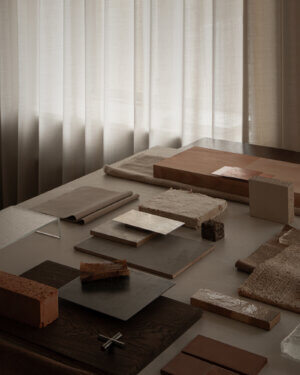
ST In terms of materials, we’ve focused on adding in everything haptic and tactile. Everything you touch has been carefully considered, from the timber of the bar to the way it is detailed and finished. We’re interested in how materials feel in the hand and how they contribute to the overall atmosphere of a space. Acoustics is another important aspect. To create a more comfortable and calm environment, we are integrating dried seaweed panels within furniture elements and working with mycelium panels as wall pieces that also help absorb sound. These kinds of materials allow us to address technical needs while also contributing to the sensory quality of the interiors.

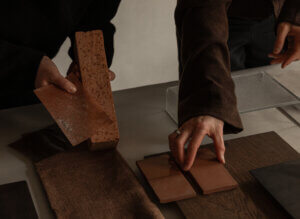
Across the project we are also exploring new, sustainable materials, which is another point on which we feel very connected to Slowness, with your genuine enthusiasm for these principles. For instance, we are using a bio-resin from Natural Material Studio. It has a softness to it that recalls rubber but it’s translucent. At Flussbad, we are exploring applying a version that has a brick dust suspended in the resin, so that the material carries a hint of the color and memory of the surrounding structural architecture.

Visually, we are working close to monochrome in order to mute the noise of visual expression. So more than creating contrasts between colors, we are building contrasts in texture and haptic qualities. The timber is soft and oiled. The tiles are smooth and hard. The eelgrass introduces a more fibrous, tactile texture. There are also metal elements whose relief comes directly from the manufacturing process, expressing a kind of natural ornamentation through their surface. So we create tonal shifts and material layers that echo the diversity of textures found in nature without relying on strong colors.

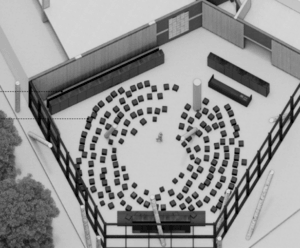
  • A modular auditorium model

AS Flussbad is built as a kind of matrix for holding a series of rituals. And ritual is one of those human universals, people everywhere engage in one form or another. It is one of the ways that we anchor ourselves in time and in place. Are there invitations to ritual in the work you’ve done for the Flussbad interiors?

ST Slowness had already done so much thinking along these lines when we came on board that our role became about translating those thoughts into something physical – into spatial gestures and sequences that gently guide how the space is used. A bar counter, for instance, invites pause, with a slightly sunken surface that helps to establish natural eye contact between seated guests and staff. A small wooden tray clearly indicates where coffee is to be collected, removing ambiguity through quiet cues. Shifts in material signal changes in atmosphere and function. I want to create little moments where, as a user, you automatically understand how things should be used. These cues help you navigate without needing instructions, creating a sense of ease and clarity.

Most people feel more comfortable when they instinctively understand how things work. In many ways, that’s what rituals do – they create a shared understanding of how to be in a place together. When you recognize these patterns, you feel part of a community. You feel included and at ease. The gentle nudges we introduce are meant to give guests that sense of confidence and belonging.

Sometimes a placement of seating indicates gathering, but it is equally important that the space leaves room for solitude when that’s desired. We’ve tried to create a spatial rhythm where moments of gathering and moments of retreat coexist naturally. When the environment supports both togetherness and introspection, rituals can emerge organically rather than feeling imposed.

In contrast to that, there has been a tendency in many contemporary projects to design for total multifunctionality. The idea that a space should accommodate every possible need, both now and in the future. But what you actually end up with is a big nothingness because you are not designing for a specific need. With Flussbad, because the project is so focused on rituals and experiences, the design process has felt much more intuitive and purposeful.

AS That’s interesting. If you design for everything, in some sense you’re designing for nothing.

ST Yes.

AS A space or an object or a surface that is available for any possible use is giving you no information about what you might use it for. It becomes a meaning-stripped environment if it’s so multifunctional.

ST Completely.

AS Well, thank you for sharing your thinking. Do you have any idea as to where architecture is heading next?

ST At Norm we’re not going for the big revolutions. We will continue to build on what works and what has lasted through time, continuously analyzing why it works and gaining a deeper understanding of it. It’s not that we want to go back to what has been, but we want to understand what worked in the past and bring that into our modern life. We will continue to refine that more and more, creating places that reconnect us with our senses, with nature, and with each other.

Contact
FLUSSBAD
Zur Alten Flussbadeanstalt 1
10317 Berlin, Germany
Website by Studio Airport