Slowness uses cookies to enhance the quality of our website. You can control how these cookies and similar technologies are used by adjusting your settings in My Preferences. To learn more about which cookies we use and how to edit your preferences, read our Cookie Policy.
PREFERENCES
Slow uses cookies to enhance the quality of our website. You can control how cookies and similar technologies are used on this website by making a selection below.
Save Preferences
Want to learn more about our people, places and projects? Sign up below to get our occasional newsletter.
Multimedia

Portrait

Ayumi Paul: The Earth Might Glow

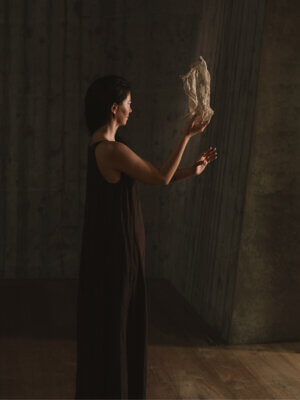
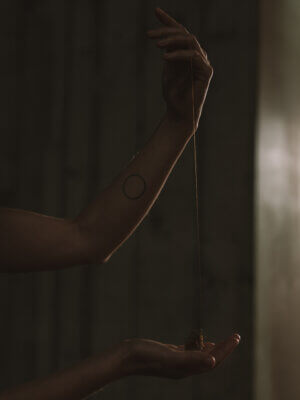
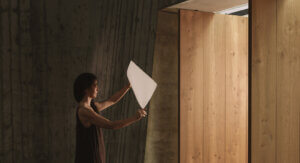
“There is no such thing as a non-vibrating object,” says Ayumi Paul, a multidisciplinary artist, violinist and orchestrator whose practice spans sound, paper, installation and textile works. Through resonance, Paul has found a way to both hear and speak to all manner of phenomena, from river sources and sunsets to muses. Approaching art as a ceremonial practice and listening as a relational force, she engages with broad fields of scientific and historical research, consistently returning to the body and its inherent ways of sensing and knowing. In this Portrait, Aurora Solá draws back a curtain on the strikingly original methods of a multidisciplinary artist.

  • Words Aurora Solá
  • Photography Clemens Poloczek

“There is no such thing as a non-vibrating object,” says Ayumi Paul, a multidisciplinary artist, violinist and orchestrator whose practice spans sound, paper, installation and textile works. Through resonance, Paul has found a way to both hear and speak to all manner of phenomena, from river sources and sunsets to muses. Approaching art as a ceremonial practice and listening as a relational force, she engages with broad fields of scientific and historical research, consistently returning to the body and its inherent ways of sensing and knowing. In this Portrait, Aurora Solá draws back a curtain on the strikingly original methods of a multidisciplinary artist.

  • Words Aurora Solá
  • Photography Clemens Poloczek

Ayumi Paul was trained in classical violin from the age of five, but when she was invited to present her first solo show at Kunsthalle Osnabrück in 2019, she decided to use a different instrument. “Unlike the violin,” Paul says, “the voice is something all of us have in common.” And Paul wants to involve all of us.

Inducing museum-goers into instances of spontaneous, unscored song has become a specialism. Since graduating from the Hanns Eisler School of Music, Paul’s studies of the human voice have included excursions into overtone chanting, classical opera, healing traditions and the Tao of Voice. The sessions she holds — Paul calls them singing sculptures — frequently take place on dates of calendrical significance or cosmic meaning, such as solstice. Paul is pursuing a question that contains almost infinite recesses, to wit: “How can the human voice soften boundaries, dissolve binaries and static ideas of identity, and catalyze forms of knowledge that are nested within the reverberance of bodies and places and the more-than-human realms?”
Source of the River Cephissus by Ayumi Paul
Ayumi Paul

“​​I observe that the technologies that we have in our minds and bodies are far more advanced. In my work, I dedicate a lot of time to practicing these inherent tools. Like anything, if we don’t practice it, we won’t be able to use it.”

This inquiry informs The Singing Project, which develops through research, deep listening and oral transmissions. While song is lighter than air and prone to vanishing, Paul’s ambition is dazzlingly concrete: “I project,” she writes, “that one day this practice will be integrated widely into daily life — schools, parliamentary debate, negotiations between opposing interests, the communication between caregivers and those they support, burial and birth rites and into the ways we sit in council.”

“​​If one day a great many people around the world were to sing simultaneously and join in the totality of sound on Earth, the Earth might well glow,” Paul told Patrizia Dander of Gropius Bau, another museum at which the Project has been presented. “It’s all possible; it’s not at all inconceivable.” And to the extent that museums are still the shrines of the Muses, then The Singing Project is quite at home in them, honoring the goddesses of the arts in the manner with which they are familiar, with poetic incantations and music.

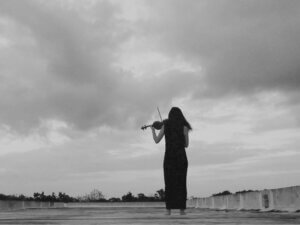
It is hard to shake the sense that Ayumi Paul is an artist in the mold of the mythical bard Orpheus, who with his songs would heal the sick, bring back the dead, and charm animals, trees, even stones. Perhaps it is humans that are most resistant to enchantment. “At sunset, the entire natural world is in symphony, except people,” says Paul. Earth Rhythms​​ is a corrective prelude: in a 28-minute still shot, we see Paul improvising on the violin while standing on a roof, in concert with the creatures and winds that become more animated at dusk, while all the while, frame by frame, almost imperceptibly, the visible disappears into the darkness. The sounds go on.

Earth Rhythms, 2020
Ayumi Paul

“I listen with my eyes, I love listening with my hair, I listen with my skin. By listening I mean going out of focus — into a less penetrating, more receiving state. More being-part-of and less goal-driven.”

“More than 99% of reality is invisible,” Paul correctly notes. This interest in participating with the invisible majority runs through Paul’s multidisciplinary practice. “I believe enchanting is one of the oldest job descriptions of the artist — connecting the world we can see and the world we cannot, weaving between the present moment and the world where there is no time,” she says. In There Is Always Sunrise, the work Paul brings to Reethaus, she sings with the gurgles and eddies of the source of the River Cephissus in Boeotia, Greece. “It’s not part of my practice to find more incredible microphones to capture something that my ears cannot hear,” Paul explains. “My tools are more intuitive.”

In There Is Always Sunrise, singing is the final act, the ripe gesture; the work begins with recovering ranges of perception that have fallen out of use. Paul spent five days listening to the river before raising her voice to meet it. “I listen with my eyes, I love listening with my hair, I listen with my skin. By listening I mean going out of focus — into a less penetrating, more receiving state. More being-part-of and less goal-driven.”

This subtlety may be Paul’s most important contribution to the present fever. “I find technology very, very interesting,” she says, “and yet I observe that the technologies that we have in our minds and bodies are far more advanced. In my work, I dedicate a lot of time to practicing these inherent tools. Like anything, if we don’t practice it, we won’t be able to use it.”

Contact
FLUSSBAD
Zur Alten Flussbadeanstalt 1
10317 Berlin, Germany
Website by Studio Airport